Category: Old School (Page 27 of 29)

James Harden’s Beard Keys Thunder Victory

Yesterday, the Oklahoma City Thunder advanced to the Western Conference Finals with a 105-90 victory in game seven over the Memphis Grizzlies. As a key reserve and generally the Thunder’s first player of the bench, James Harden’s beard scored 17 points (most of it via four three pointers he nailed), collected four rebounds, had four steals. And in the process throughout the series, he made it cool to have a beard again. For everything that Brawny paper towels tried to do by replacing the iconic “Brawny Man” and limiting his beard, James Harden’s beard is single handedly reversing the trend.

Terrell Brandon enjoys the time in “his” BarberShop

Terrell Brandon is more than just a former NBA star these days – he’s a barber. That’s right, Brandon opened up his own barber shop in the Portland neighborhood where he grew up. The name? Terrell Brandon’s Barber Shop.

Here’s what Brandon has to say about his shop, courtesy of ESPN:

Brandon spends five days a week at his shop, which he says reminds him of his days in the locker room.

“Guys can open up and say all types of things and walk straight out of the door and know it will not be repeated, no matter what,” Brandon said. “That’s how it is in the barbershop — it’s honest and guys can talk about sports, their ladies or politics. It’s good to see people enjoying themselves and being able to get a haircut too, but it’s the conversations we have that make me feel good.”

For more about Terrell Brandon’s latest endeavor, check out the article on ESPN.

The Bearded Age – A history of presidential beards

Here’s another great article from The New York Times, this one about how Abraham Lincoln was the first American president to sport a beard and how he ushered an age where all but one president had a beard or mustache when elected over a 50-year period.

Here are some highlights from the article:

The story of how Lincoln decided to let his chin whiskers sprout has been retold so many times that it’s almost legendary: Grace Bedell, an 11-year-old in upstate New York, wrote him a letter a few weeks before the election. “I have got 4 brothers,” she told the Republican candidate, “and part of them will vote for you any way and if you let your whiskers grow I will try and get the rest of them to vote for you. you would look a great deal better for your face is so thin. All the ladies like whiskers and they would tease their husbands to vote for you and then you would be President.” Lincoln replied to the “dear little miss”: “As to the whiskers, having never worn any, do you not think people would call it a piece of silly affect[at]ion if I were to begin it now?” Just days after his election, though, he made up his mind. “Billy,” he supposedly told his barber, “let’s give them a chance to grow.”

*****

Yet there was much more to it than that. For more than a hundred years, American men had, nearly without exception, gone clean-shaven; in the late 18th century, a Philadelphia woman considered it noteworthy when she saw “an elephant and two bearded men” in the street one day. Now, in 1860, beards seemed to be sprouting everywhere, proliferating as rapidly and luxuriantly as some new species of invasive tropical plant.

Most American historians, when they have considered the 19th-century whisker revolution at all, have assumed it had to do with Civil War soldiers avoiding the inconvenience of shaving. In fact, the phenomenon predated the war by a number of years – and was the subject of a great deal of contemporary comment and debate. By the mid-1850s, talk of a “beard movement” was sweeping the nation. In 1857, an intrepid journalist strolled through Boston’s streets, conducting a statistical survey: of the 543 men he tallied, no fewer than 338 had full, bushy beards, while nearly all the rest sported lesser facial hair of various sorts. Only four were “men of the old school, smooth shaven, with the exception of slight tufted promontories jutting down from either ear, as if designed as a compromise measure between the good old doctrine and modern radicalism.”

As that remark suggests, antebellum beards bristled with political connotations. American newspapers reported that in Europe, beards were seen as “dangerous” tokens of revolutionary nationalism, claiming that the Austrian and Neapolitan monarchies even went so far as to ban them. In England they were associated with the sudden burst of martial fervor during the Crimean War. When the trend reached America, connotations of radicalism and militarism traveled with it, spanning the Mason-Dixon Line. It was no accident that the timid Northern Democrats who sympathized with slaveholders – like President James Buchanan – were called “doughfaces.” Meanwhile, the Republicans’ first standard-bearer, John C. Frémont in 1856, had also been the first bearded presidential candidate in American history. (The most famous antebellum beard of all, though, was John Brown’s.)

Will we ever have another beard movement?

The Barbershop Raneaissance in New York (and elsewhere)

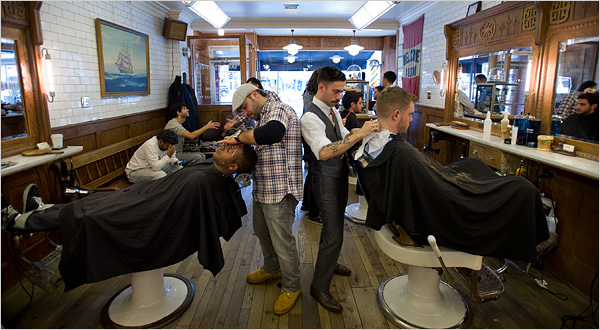
The New York Times has a great article on the barbershop trend on how it’s sweeping Lower Manhattan in New York City.

“As soon as I saw the place, I felt this deep, inner yearning,” he said. “It’s very striking, with these red barber chairs and this fantastic photo-mural. And it’s rare to see well-dressed, well-groomed men cutting the hair of equally well-dressed guys.”

He was convinced that he’d found the spot where he could get the short, early-1960s-model haircut — complete with a neat side part — that he had wanted for years. And he was right.

Moreover, Mr. Chirico, 26, discovered what other young men in New York have begun to notice in recent months: In the city’s more style-conscious ZIP codes, there has been a renaissance of that much-loved old neighborhood standby, the barbershop.

Proving Fran Lebowitz’s oft-cited dictum that “you’re only as good as your last haircut,” authentic-looking barbershops have popped up all over lower Manhattan. Done up with, say, vintage lighting fixtures, antique barber chairs and, of course, a big glass jar of blue Barbicide on the counter, they are offering good, solid haircuts and shaves for less than half the price of a fancy salon cut. And in a kind of tonsorial version of chicken-or-the-egg, their arrival is perfectly timed, coinciding with the twin desires among urbane young men to tame their unruly locks and look neater and sharper from the neck up, and do it in all-American, gentlemanly, modestly priced fashion, far from the salon smells of peroxide and perfume.

The article points out that there’s a wide variety of barbershops in the city but that many of them can be found in lower Manhattan.

As we know very well, however, this trend goes far beyond New York, and the interest in vintage shaving methods is expressed in more ways than just the resurgence of traditional barbershops.

On eBay, according to a spokeswoman, there’s been a surge of interest in vintage shaving, grooming and barbershop paraphernalia. In comparing a two-week period earlier this month with a two-week period six months ago, she said sales of merchandise returned by the search term barbershop were up 77 percent, sales of Barbicide were up 60 percent, and sales of items found by searching for the words vintage barbershop sign were up 251 percent. On Amazon, archaic devices like straight razors and safety razors, and grooming products (including mustache wax and combs) from Gilded-Age-y brands like Edwin Jagger and Colonel Conk have been selling so well that Amazon created a special category — “classic shave” — to showcase them all. Charles Kirkpatrick, the executive officer of the National Association of Barber Boards of America, said that the number of licensed barbers had grown roughly 10 percent in the last two years, to 245,000 from 225,000.

These are trends that we’re happy to celebrate.

Pete’s BarberShop is “Real Old School”

Pete Kithas in his barber shop.How many people can go to work at the same place for almost 50 years and still love it? Pete Kithas is one of those lucky ones who can say he’s right were he wants to be everyday he goes to his shop. It also looks like Pete’s Barber Shop is about as Old School as you’re going to find as most of us have never been out to get a cut at a man cave like Pete’s.

From the MetroTimes:

The shop leaves little doubt this is a hangout for the boys. The reading material is the type nobody actually reads: magazines like Penthouse and Playboy and Maxim. The language is locker room. The humor is raunchy.

“It’s an old-fashioned barbershop — no kids, no woman, just man,” the boisterous 79-year-old Kithas says in his still-thick Greek accent. “Lots of policemens.”

Finding him isn’t easy. His shop is on a second floor, up a tall staircase and down a long aisle that runs through Metropolitan Uniform, an 85-year-old police uniform and equipment supply store. There’s no door between the two businesses, no wall either. Take two steps and you’re out of one place and inside the other. And since the cops shopping for new uniforms find themselves feet away from a barbershop, many have become regulars here.

“You see now, you see those guys, we bullshit a lot,” Pete says of the coarse give-and-take. “I come here, I make some money. I have a lot of fun. All my customers over the years are all my friends.”

Sounds like my kind of barber shop!

« Older posts Newer posts »

© 2026 BarberShopBlog.com

Theme by Anders NorenUp ↑